"The Blue Studio"
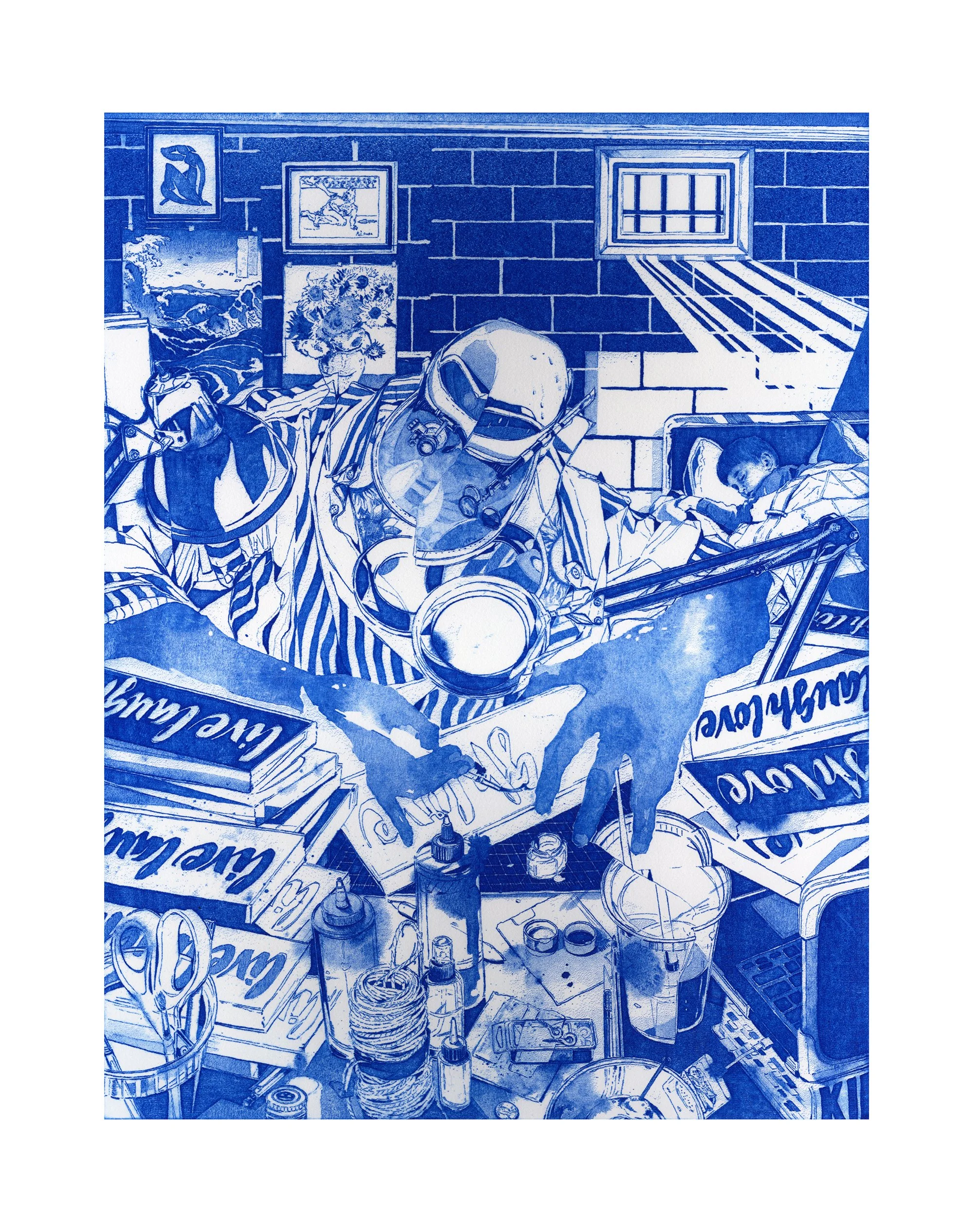
"The Blue Studio"
For those of you familiar with my recent solo show in Boston at LaMontagne Gallery, this print was created from one of my favorite pieces in the show, titled:
"The Blue Studio (But I’m talking about the same kinda work, the same style, so people can recognize it and don’t get confused, you know? Then once you’re famous, airborne, you know, you gotta keep doin’ it in the same way... even after it’s boring. Unless you want people to really get mad at you, which they will anyways.)"
The full title of the work is a direct quote from Julian Schnabel’s 1996 film Basquiat, starring Jeffrey Wright. There is a wonderful scene in which Basquiat asks his friend Benny, played by Benicio Del Toro, "How long does it take to get famous?" Benny quickly responds, "Four years, six to get rich..." and then proceeds to explain a blueprint for fame and wealth based on an artist's ability to be a socialite and continuously produce the same work for the market.
The print's consolidated title, The Blue Studio, focuses on its reference to Henri Matisse's iconic painting The Red Studio. The evolution of artists, and art history itself, is filled with stories of changing trade relations, advances in mass production technology, and market pressures, all forces through which certain works, ideas, and artists become more or less valuable to the public and to history itself.
An example would be Japan reopening trade relations with the West beginning in 1854, after more than two hundred years of relative isolation. By the 1860s and 1870s, European markets, especially Paris, began to be flooded with traditional Japanese woodblock prints that would profoundly inspire a new generation of painters. One artist particularly influenced by the Japanese approach to constructing space and flattening color was Van Gogh, who amassed an impressive collection of these affordable prints himself.
The evolution of printing technologies has also changed our relationship to the cultural value placed on singular art objects and, further still, certain singular artists, often at the expense of other forms of visual culture valued by a broader public. But these technological and economic developments are also paralleled by authentic creative evolution, both in artists themselves and in the communities they build.
The original drawing was ink on paper, and this print was made painstakingly through a highly inventive engraving process and printed using a traditional intaglio approach being pioneered by Johnny Adimando, master printer and owner of Suneater Studio in Providence, Rhode Island. I have worked with Johnny on several editions over the years, and this beautiful print reflects both the continued evolution of our collaboration and the development of his innovative approach.
The full size of these signed and numbered prints is 20" × 15", with the image itself measuring 16" × 12", and the edition size is 12 total. The heavy paper is embossed at the edges from the plate, similar to an etching process.